COMPARTIR :
Doña Urraca, the Bridge Burning Queen of the Camino
17 de Octubre del 2026
Doña Urraca I has only one mention in Liber Sancti Jacobi, the medieval manuscript that describes the Camino de Santiago.
The single reference is very suggestive.
Towards the end, the author lists off the men who “moved by devotion and love for God and the Apostle, rebuilt the Way of St. James from Rabanal to Portomarín before the year of our Lord 1120.”
Last on the list comes Pedro, who rebuilt the bridge over the Miño “destroyed by Queen Urraca.”
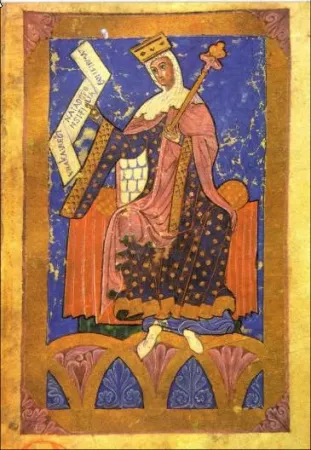
You’ve likely never heard of Urraca, but you should have. Because while Elenor of Aquitaine went off on crusade and wore two crowns, she did so merely as a consort. Urraca, by contrast, was queen of Spain in her own right, as the successor to her father. She is considered the first woman in western Europe to rule in her in her own name, not as a consort or regent.
And her life and rule played out along the Camino de Santiago.
Urraca was most likely born in 1080 in Sahagún or León, both cities’ pilgrims will recognize. Her father, Alfonso VI, had been instrumental in building up the Camino de Santiago (the French Way).
By then, the Christian kingdoms of the north held the power advantage vis-a-vis the Muslim caliphates of the south and Alfonso VI had made long strides in the Reconquista, recapturing Toledo and Coimbra, and making the Islamic kingdoms at his borders his vassals. Gone were the days when the Castilian plain and even Santiago itself suffered incursions from caliphate of Cordoba. Alfonso’s father had already consolidated his hold of the Castilian plain, but under his son it would enter a new era of prosperity.
Through his second wife, Constance of Burgundy, Alfon had allied his kingdom with the powerful French one, the Cluniac monks, and the papacy. Cluny monasteries were founded in Fromista, Sahagún, Burgos, and Villacazar de Sirga. New populations from all directions— Christians from the south, French from the east, and Spaniards from the north—built the towns of the Camino de Santiago into a bustling, international, and prosperous corridor of trade and traffic. This situation also created some tensions between the new urban bourgeoise and their religious or noble overlords, which will play out to on Urraca’s life.
At the same time, in Santiago de Compostela, bishop Diego Gelmírez was in close contact with the papacy, getting his diocese elevated to an archbishopric, and making strides in the rebuilding of the cathedral, the one still standing today. The Codex Calistinus demonstrates the interconnection of these factors. Written by a Frenchmen during the lifetimes of Alfonso VI, Urraca, and Diego Gelmírez, the author attributed much of it to Pope Calistus II, who had been a Cluniac abbot before ascending to the seat of Rome and appointed the Galician bishop to Santiago. Urraca had a deep connection with Santiago de Compostela, too, as her father gave her Galicia as her wedding present, naming her its condesa. She also married a Frenchman.
When Alfonso lost his only legitimate son, Urraca’s brother, in a battle with the Almoravid forces, who were attempting a comeback in the early 12th century, he named Urraca his heir. Then he died in 1109.
At the time of her father’s death, she was, about 30 years old, the mother of a son, and a widow in a man’s world. She had already taken a lover among the nobles of her kingdom, but her father and the body of aristocrats thought the best marriage for her was with Alfonso I of Aragón, better known as the Battle Axe (El Batallador). They hoped bringing this strongman on side would quell any pretensions from the up-and-coming kingdom of Navarre to make moves on the Leonese holdings, as the marriage contract stipulated each spouse retained control of their respective kingdoms while also supporting their spouse against enemies.
With a name like battel ax, that ought to have considered that The Aragon king would not prove a man of peace. Of course, Urraca would be remembered as La Temeraría, The Reckless. This marriage was always destined for either great success or total disaster.
The problems started immediately. A brute, Battle Ax couldn’t contain his violent tendencies even in public, including in his actions towards his wife. Beyond those interpersonal problems, the Galicians had no more love for the Aragonese king than Urraca did and went into full rebellion against León. In response, the pair headed off to Galicia with troops, Alfonso laying on his full force against the rebels, and going further in his violence than pleased Urraca. She was particularly appalled at his killing of a rebel noble who had surrendered.
Urraca returned to León ahead of Alfonso, and steaming mad. So were other of her Spanish subjects. On Alfonso’s passage through Astorga, the city refused to let the Aragonese king enter to spend the night. In León, Urraca and Alfonso fought bitterly. Then they seemed to reconcile. But Urraca then made a definitive move. She decided wanted out of the marriage. She had quite a bit of support for such a move, as church authorities had never fully approved of the union since the two cousins. Some aristocrats also took her side.
Urraca’s application to the pope for an annulment must have caught Alfonso off guard, and he didn’t like it. As Urraca made haste to the monastery of Sahagún to await the papal decree on her marriage far from the fists and fury of her husband, the Batallador caught up to her, kidnapped her, and locked her in the tower of El Castellar in Aragón. He then gathered his troops and headed back to Urraca’s kingdom to avenge himself. In a sweeping campaign, he took all the Castilian cities except Astorga and León. He even captured Toledo, and the Galician city of Ourense.
The nobles loyal to Urraca soon reacted, gathering their own forces with the support of the French and freeing their queen from her imprisonment. I’ll skip the long list of bellicose interactions and constant intrigues, changes of loyalty and subterfuges that ensued. To summarize, Urraca’s rule was contested and challenged from multiple sides—Galician nobles and the city’s archbishop Diego Gelmírez (with whom she had left her son), her half-sister Teresa in Portugal, and, of course, her eventually ex-husband.
But in the end, Urraca got them all. Despite her military disadvantage, she had the one thing neither her half-sister nor her ex-husband could boast of—a rock solid rightful claim to her throne. To make a long story short, she appeared to alternately placate both her husband and her half-sister but then conspired against them both with the Galicians, forcing Alfonso to give up most of what he had captures and taming Teresa’s pretensions.
These adventures took her from one end of her realm to another and all along The Camino. One of the most harrowing episodes of her life took place in Santiago de Compostela itself. In 1119, the bourgeois lead an uprising against Gelmirez, who in his turn had essentially rebelled against Urraca by naming her son (another Alfonso) the sole ruler of Galicia. But when Urraca entered the city, the rebels fell on her, her entourage and her troops.
The queen, the bishop, and their respective entourages took refuge first in a palace next to the cathedral and later in the cathedral’s bell tower, which was still under construction.
Little refuge they found, as the angry mob thrust burning cloths and wood through the windows.
They had to escape. The archbishop managed to disguise himself as beggar and slip the crowd while Urraca had no choice but to take them head on.
According to the Historia Compostelana, a 12th-century chronicle, the rebels “rushed at her, seized her, and threw her to the ground in the mire. They set her like wolves and tore at her clothes."
The queen was beaten, dragged through the mud, and stripped half-naked in public view. "Many wanted to stone her," the chronicle continues, and a woman "wounded her severely on the cheek with a stone."
Urraca somehow managed to flee and take refuge in the Church of Santa María, where Gelmírez also arrived later. The mob then came to its senses, it seems, and escorted Urraca to the Church of San Martín, while the light-footed Gelmírez had to flee across the city’s rooftops, saving his life almost by a miracle.
Not surprising, then, that in this turmoil, the bridge over the Miño in Portomarin got destroyed.
Luckily for pilgrims, the military and political interests of this dispute required that roads and bridges be in good condition more often than bad. In the end, this terrible marriage breakup repaired more than it destroyed. Urraca herself not only funded the rebuilding of the bridge but also generously endowing the monastery of Santa Marina which also ran a large hospital that sheltered pilgrims. Alfonso the Battle Ax, too, had kept the Camino in ship shape to ensure the flow of his troops.
Urraca died in childbirth in her castle at Saldaña, in 1126, and her kingdom passed to her son who was crowned as Alfonso the VII. He completed his work of reconsolidating the kingdom from its opponents.
Though she died in Saldaña, a lovely town in Palencia not far from Fromista, she was buried in León in the romanesque church of San Isidoro. Her granddaughter and namesake, Urraca of León “the Asturian,” is buried in Santiago de Compostela.
History would not be kind to Urraca in the next several centuries, but tides eventually turn. Now, naturally, she is regarded as an outstanding woman, particularly for her time. From a Christian perspective of holiness, she was certainly no worse than her male contemporaries regarding a lust for power. I simply like to call her the queen of The Camino.
She may not be a saint, but when passing through León, its worth paying her homage to the Reckless on who beat the Battle Ax on The Camino. I mean, who would you have wanted to win?