COMPARTIR :
Hiking the Hippie Villages of León
22 de Agosto del 2026
The Montes de León in northwest Spain are best known for the mountain pass between Foncebadón and El Acebo marked by the Camino de Santiago and the Cruz de Fierro. Less known is the rather hidden life of the hippie villages perched on the slopes of these mountains through which the Camino does not pass, though other trails do pave a way.
From the town of Foncebadón, almost at the tippy top of Mount Irago and on The Cmaino, you can look to the north into the Valle Real where Matavenero is hidden and whose rebirth is its own story running parallel to that of The Camino.
Foncebadón had gone from being important enough in the Middle Ages to host a local church council and have a pilgrim’s hostel to having two residents herding a small flock amid the ruins of the town in the early 80s. Heading down the main road on either side of it, a few people called El Acebo and Rabanal del Camino home, but Manjarín was completely abandoned, officially erased from the map of Spain. In the Valley of Compludo to the north where a paved road led to an historic iron forge converted into a living museum in the 1960s, a dozen or so people still lived. But Valle Real to the south, accessible only by forest roads and footpaths, was completely abandoned. The human settlements of Matavenero, Poibueno, and Fonfría, in the Valle Real, had also been officially obliterated off the map by time, bad luck, changes in lifestyle and economics, neglect, and public administration. Only ruins remained. Then a wave of new life started to role in, a combination of hippies and pilgrims and entrepreneurs of the tourist industry.
In the 80s, Fr. Elias Valiña painted yellow arrows to mark the Camino de Santiago through Foncebadón, Manjarín, over Mount Irago and down through El Acebo. Around that same time, a group of German hippies were roaming Spain looking for a place to build an off-the-grid community. They found Matavenero in the Valle Real. On the top of the mountain, a Tomás had also moved into Manjarín. Tired of modernity, he decided to revive the spirit of the Knights Templars and offer hospitality to pilgrims on the Camino de Santiago.
In the nineties, the Association of the Friends of the Way of St. James turned Foncebadón’s crumbling church into a pilgrim’s hostel, and a couple of ceramic artists opened the medieval-themed Taberna Gaia. This initial wave swelled over the years. Now, El Acebo has three restaurants and at least two pilgrim hostels, including one with a spa opened about six years ago. Foncebadón has several small restaurant-bars, several hostels for pilgrims and non-pilgrims, and an Italian pizzeria, though it hasn’t entirely lost the semi-neglected, bohemian feel it had when I walked through it for the first time in 2010.
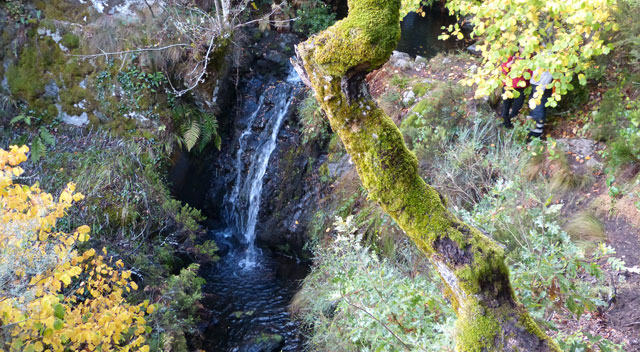
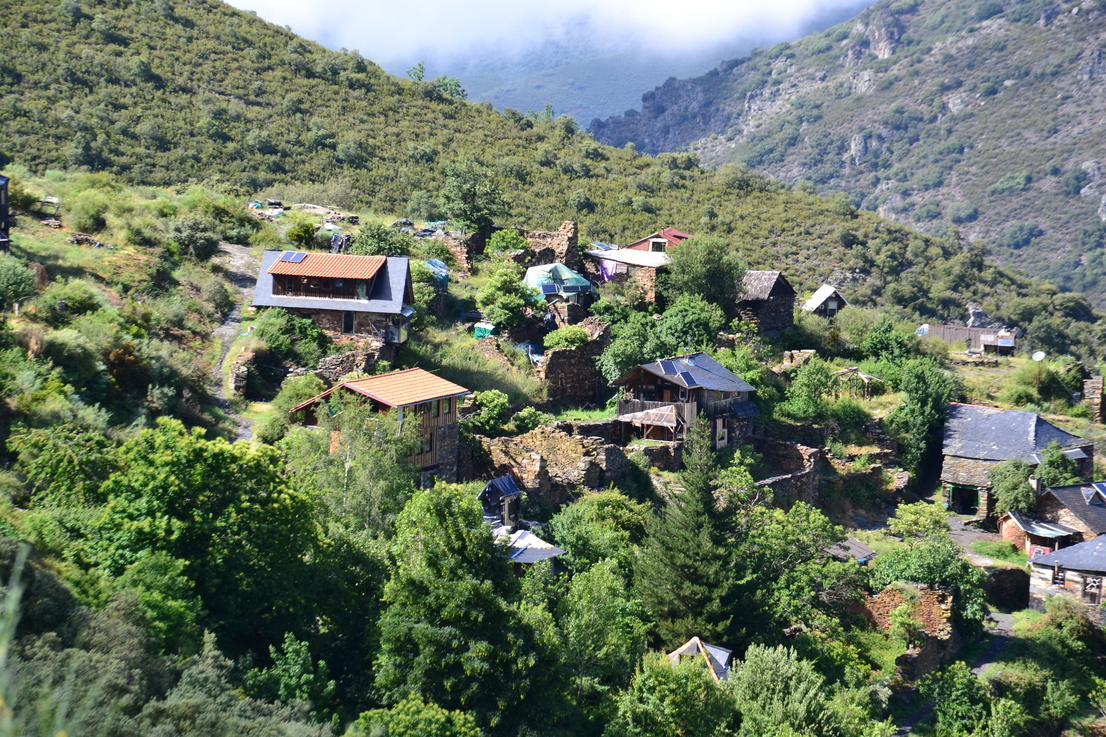
Getting to Matavenero still requires driving down a dirt forest service road and them walking down a steep footpath to reach the rows of houses winding along the side of the mountain. Not paving the road was an agreement the village’s new residents made with local Spanish government. The first reaction of any typical modern person is how did, do, people actually live here? But if you think that’s impressive, Poibueno, a kilometer below on the valley floor, had a lovely stone church on the banks of the river. Getting the materials down there to build it must have been difficult in past centuries and still can’t be easy today, as it too is only accessible by foot path. Still, some brave souls have made it home. Only slightly less incredible is Fonfría, which sits on the opposite slope of the valley from Mataveneros and was the capital, so to speak, of this valley community. You can reach it by car if you’re willing to rodeo over bad dirt roads. Here, too, a second wave of hippie-types moved in, rebuilt homes, planted gardens and rigged water systems. Few stayed long-term, though, so now it’s most often visited by hang-gliders sailing off the cliffs on windy days.
The best entrance to the valley, though, is at San Facundo, a lovely little town not far from Ponferrada. Think of Valle Real as a high-walled circle with one small opening. That opening is San Facundo, which is definitely not a hippie village nor, since it’s on the wrong side of the Montes de León, a stop on the Camino de Santiago. Instead, it’s a picturesque village of the Bierzo wine region where people have summer homes and tourists wander around the paved streets admiring the quaint combination of a naturally beautiful backdrop and houses maintained or repaired just faithful enough to the traditional architecture to keep it pretty. There’s also a nice restaurant where you can have a drink or lunch or dinner. Or you can hike the Valle Real, the natural attraction, and catch a glimpse of the hippie renaissance. Last Sunday, many escapees from our work-a-day world in the city like my husband and I wandered through the valley, Matavenero, and Poibueno. The residents of Mataveneros seem to take their slight notoriety (the story of the village is pretty-well known in the region) and inevitable visitors in stride, or perhaps with their tongues in their cheeks. I saw this sign placed at the entrance of the village: “Tourist’s Guide: Ask at the house of Uli and Julia in the old town-historic center.”