COMPARTIR :
Lost Villages and Señorial Manors
26 de Agosto del 2026
On a Sunday in late winter, the 1st of March to be exact, we took an excursion to Murias de Paredes, a village west of us up in the mountains. We went on the excuse of a workshop there on the traditional leonese herb garden, but when we pulled into town at eleven-thirty in the morning and found the town completely quiet, I suddenly realized I had gotten my days and dates confused. The workshop had been the day before. Here absolutely nothing extraordinary was going on. In fact, we wondered if we would even find a bar open to have a coffee.
Luckily, the people in these little places are quite accommodating and we found taped to the door of La Casona, a Baroque mansion now serving as the village cultural center, a note informing us that visitors were welcome to call this telephone number if they wanted to see the historic building.
I called and the owner of the phone number answered right away. We agreed to meet at one o’clock. She also assured me that the village bar would open about noon.
We had rescued our seemingly failed adventure.
Local History
Today Murias de Paredes holds the distinction as the principal village of the Reserva de la Biosfera Valles de Omaña y Luna, a protected area that encompasses some 81, 000 hectares of two valleys at the intersection of two mountain ranges, the Cordillera Cantabrica and the Montes de Leon. The bioreserve distinction includes protections not only for the natural heritage of the area, also its human culture, a span of practices and activities reaching back at least a millennium. No, the town is not frozen in time, so to speak. No one wears old-fashioned peasant clothes anymore. Homes have running water and electricity. Paved roads reach the village and cars drive in and out. But these mountains also hold on their slopes ruins of old castles, original stone masonry, ancient archeological sites, Visigoth art, historic churches, and pre-industrial farming practices. Here preservation is life, not necessarily museumification and tourism. Locals still gather wood from the village lands using the medieval rules of the concejo, the village council. Extensive cattle farming still goes on here, too, carried out with the help of leones mastiffs. Here is conserved the biocultural landscape of many centuries.
Geologically, Murias de Paredes sits in a glacial valley. Beyond the village, geological processes have formed hillsides of fossils; imprints of ancient plants; dolomite, marble, slate, and carbonite formations.The mine of La Cobriza, within hiking distance from Murias de Paredes, stored minerals, particularly large amounts of copper, exploited by locals and empires for about a millennium. A bit further away glacial lakes, las Caldas de Luna, still gleam with mirror-like clarity. Oak forests still provide habitat for brown bears, eagles and falcons, grouse, deer, and even wolves.
The human genealogy reaches back at least to the celtic cultures that dominated northwest Spain from the Bronze Age until the arrival of the Romans, about the time of the birth of Christ. The Roman historian Pliny the Elder, wrote much about the Roman exploits in northern Spain and the bellicose “Homus Manium,” or god men, the Roman Empire encountered here. Archeological digs have uncovered remnants of their castros–walled villages of stone and thatched-roofed round houses strategically placed on hilltops. The found, too, a druid idol, near where today stands the Hermitage of the Seita. Roman canals dug into the mountains to transport water for mining–the Romans heavily mined the Cantabria Mountains for gold–remain etched into the rock and dirt, today transited by humans as paths around the mountains.
Eventually the Roman Empire fell to the Germanic peoples pressing in from the North and East. The Visigothics took over in Spain in the fifth century, marking that process of change from Antique Rome to Medieval Europe. In Hispania, as it would have been known as then, another historically significant event closely followed on this, namely the conquest of the Visigoths kingdom by the Umayyad Caliphate from north Africa. In 778, what was left of the Visigoth nobles had taken refuge in the Cordillera Cantabria. Subsequently, La Reconquista commenced with the Visigoth lords quickly reclaiming what is today Asturias and Leon. During these years, new villages were often established in the regained territory and in general, the descendants of the Visigothic nobility, now ruling from Oviedo and then Leon, reintegrated the territories of their expanding ruling into their power.
Murias de Paredes appears in the medieval historical record during the early stages of said reconquest. Specifically, the medieval documents conserved in the Cathedral of Oviedo, the city in Asturias where the Visigothic kingdom had reconstituted its capital, shows that Alfonso the Chaste, who died in 842 after a long reign, had incorporated the village into the dioceses of Oviedo. This is a good moment to note that the village sits on the Camino Olvidado, the forgotten Way of St. James, a route used in the 10th century to transverse northern Spain. What we today call the Camino Frances was not yet well-established as the Caliphate of Cordoba was quite strong at the time, and liked to send raiders into the Spanish kingdoms to its north.
in 1462, the King of Castile (Castile had eclipsed and incorporated Leon but that’s another story) established the Condado de Luna, along with a noble title, and the gift much of Murias de Paredes and other villages to the Count of Luna, one Diego Fernandez de Quinones. The villagers didn’t become his serfs and the concejo did not entirely disappear but they did now have to answer to him and pay him taxes.
La Casona de Murias de Paredes
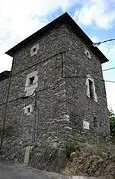
The Condes de Luna left their historical mark in Murias de Paredes, principally in the form of La Casona, a Baroque-style stone mansion built at the end of the 17th century or the beginning of the 18th century, to use as a stop in their trips to Babia, another region in the same mountains where of where Spain’s nobility liked to spend long summers.
The style reflects the baroque aesthetic and the sentiments of the nobility of the period–the two towers flanking the edifice topped with the cross of Malta and decorated by the heraldic shields of the Quinones and Porras families, who bore the title of counts of Luna. The noble title still exists, though of course, today it does not come with any of the medieval privileges of old.
As times changed the noble family stopped using their little country palace. In the 1960s, it was turned into a barracks and commissary for the Guardia Civil, the Spanish police force charged with patrolling rural areas. The ownership, though, had remained with the descendents of the counts of Luna.
In the early twentieth century, count of Luna descendent Octavio Alvarez Carballo had secured his ancient aristocratic holdings, land and buildings–by then basically private property subject to taxation by the modern state and of little use in a modern economy––into a foundation for their historic and natural conservation. In the 2000s, the foundation ceded use of the Casona to the town of Murias de Paredes, which restored it to what we see today.
The work was, in my opinion, pretty well done. La Casona is certainly not a house museum but something of the feel of the original baroque edifice comes down to us, even as it now serves as a modern interpretation center for the biosphere reserve.
The renovation reopened the original blinded holes and arches and the building’s original interior structure was restored, too. The stone inside is the original, as is the staircase, made of pink marble from a local quarry. Wood was added in keeping with the baroque style. Within La Casona, exhibits introduce the flora and fauna in the bioreserve, show the traditional dress and way of life with its tools and fireside storytelling. One room replicates an old classroom of the first modern schools.
Pilar met us there at one o’clock as promised. She gave us a shortened tour, mostly for the sake of the tiny attention span of our young children. Pilar is from Murias de Paredes and rightly proud of the Casona. The willingness and perseverance of locals like herself brought it to fruition and kept it going. She has lived, too, the culture that has made the biosphere reserve a place worthy of protection. As we talk, she cites one of the classical examples of ancient forestry practices of the concejo, of rules for felling trees.
“They only cut down every seventh one. They knew not to cut down everything,” she says.
She also mentions the systems for managing water and how the old villagers built fountains, and cleared rivers of excess vegetation to prevent flooding, at the same time creating ideal habitat for the local trout. Now she’s a little frustrated, like most Spaniards in rural areas, with the layers of bureaucracy and technocracy, the prohibitions imposed and permissions required by the central government’s agencies for environment, water, forest, and so on that often interfere with the traditional, local environmental management. It’s a common tension in rural Spain.
Village Life Today
With the counts out and modernity in, what is this village like on a regular Sunday morning?
Quiet but not as quiet as we first thought.
Before meeting Pilar we had wandered around admiring the old stone architecture and the views to the mountains. At first, we had seen only one man out and about, tending his yard by his stone house with a wooden rake that looked, quite honestly, a bit medieval.
Nowadays there is no regular Sunday mass in the village, despite the well-conserved state of the church itself, which also has its only interesting history. Its cylindrical bell tower is rather unique for rural churches in Spain. Inside, it houses a very early Romanic statue of the Virgin Mary which sits inside a gilded baroque high altar piece. The baroque high altar is inside the much older rural church is a common theme in Spain, a testament to the vibrancy of these communities and their religious convictions in the 17th and eighteenth centuries. It also shows that historical conservation is a modern idea. These rural people didn’t hesitate to insert new, contrasting and bold styles into their churches. Interestingly, the craftsmanship of these pieces can vary astonishingly, depending on who the village contracted for the job. Its also worth noting that these churches belonged to the village, not the Catholic Church as an institution with its hierarchy, administration, etc. The village, again not the Catholic Church, controlled the maintenance and decoration of the church.
We had also found the bar that opened at noon. Here, we found, the village had gathered. It was full of people, mostly over fifty but a family with a baby too. They seemed to be gathered in groups that formed informally. neighbors having a mid-morning coffee (noon is still midmorning in Spain) or an early aperitivo. The village bars serve two purposes, as gathering space for locals and a business opportunity by hosting tourists, too. Like other villages in Spain, Murias de Paredes is slightly reversing the longstanding trend of depopulation and envejecimiento, aging. Pilar told us it opened a municipal daycare center last year as a couple of families with children had taken up year-round residence. We made a reservation for lunch.
After our tour of the Casona, we wandered further from the village nucleus following the road to the next town, which runs parallel with the Omana River. We ended with lunch at the Holandes Errante which did not disappoint. The croquetas de jamon were obviously homemade, creamy, and tasty. The sopa de cocido–pork and vegetable stock with little noodles called fideos–stood out for its cloudy color and gentle flavor, again a sign that we were eating homemade food cooked by a loving hand. Sopa de cocido is one of those dishes that, perhaps because of its simplicity, regularly turns out too salty instead of flavourful or with color and consistently indicative of having been made almost entirely from a tetrabrick of store bought broth. The mollejas were delicious too, the sauce not too strong on the tomato flavor and with just a hint of picante. Installed in an old stone house, the restaurant preserved the traditional style, ornamented with antique items that gave it a European country chic ambience, though with the touch of authenticity only possible in villages like Murias de Paredes.
See a video here: https://youtube.com/shorts/Kc_gIOlJCIE?feature=share
Additional Resources:
Asociacion de Cuatro Valles: Information on hiking routes and guides, including for 27 routes that run through the Omana and Luna Valleys and far beyond. Provides information on lodging and other services in the area.
https://cuatrovalles.es/
https://omanayluna.com/
Official website of the bioreserve. Information on activities, hiking, services,a nd more.
https://sienteomana.com/lacasona/
Tourism website for Murias de paredes and its group of villages. Information on hiking, activities, services, and more.