SHARE :
The Ancient Iron Forge of Compludo
15 of September of the 2026
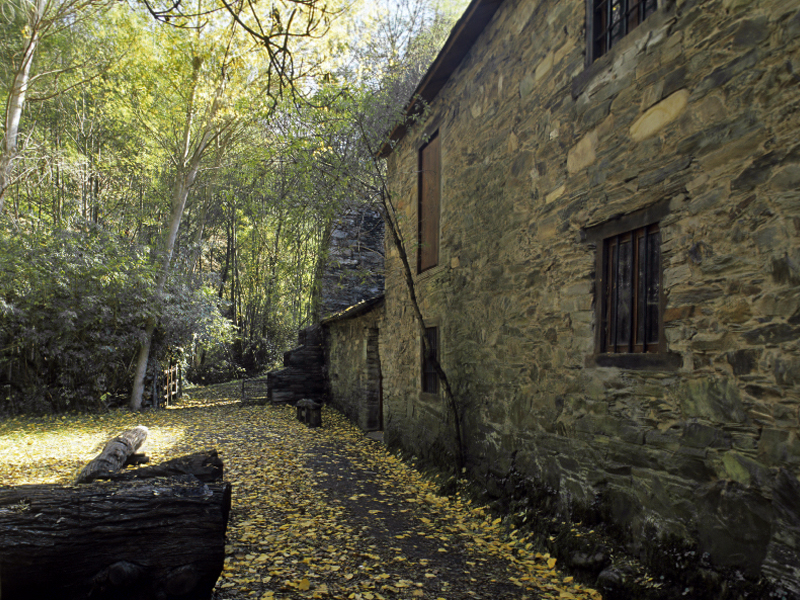
Alone in the woods, Miguel Sánchez waits for curious travelers to follow the winding road down into the Valley of Compludo and then the path along the creek to his iron smithy. A short walk into the forest, following the flow of a little river, and soon the smell of burning iron and the sound of heavy pounding announce Miguel is nearby. Finally, the visitor sees the vague cloud of smoke rising from the roof of the old stone building and knows he has found the legendary Miguel and his iron forge.

If the guest waits patiently on the wooden bench outside, Miguel will come out. You know he's there, not only becuase of the signs of activity from inside the historic building but also becuase his motorbike and faithful, perfectly trained German shepard, lay around the little yarrd, as much a part of the scenery as the leaves adn the water glistneing with filtered light.
When the time comes (the next tour), he opens the door for you and lets you in to dark, damp smithy. In exchange for four euros (just one if you’re under age 10), he’ll let you in and tell you the whole story of the place.
 .
The forge, he explains with that straight-faced, direct, and very certain way so characteristic of this part of Spain, dates to the seventh century when Saint Fructuoso founded a monastery nearby, tucked as tightly into the folds of the mountains as the iron froge is. Almost all trace of the monastery is gone, but today the tiny village of Compludo, where Miguel and about a dozen other people live year-round, remains.
Miguel will neglect to tell you that it’s more likely the forge dates from the seventeenth or eighteenth century, according to the most recent study, but the story is much better the way he says it, as the monastery nad Saitn Frustuoso certainly did exist a thousand years before. Villagers excavated the site themselvs in the 1940s. Besides, to the untrained eye the stones and arches of the forge could certainly be as old as Miguel claims.
He then explains that by the early twentieth century the forge had fallen into disuse and was all but abandoned. His great grandfather then bought it, rebuilt it, and turned it into a booming business that employed some dozen men, housed in the building right next to the smithy itself.
“I’m the fourth generation to work this iron forge,” he says leaning on the edge of the coal furnace inside the forge.
“In 1908 my great grandfather purchased it from another individual who had purchased it from another person. When my great grandfather bought it, it was in ruins. He had to rebuild almost everything. Here they made farm instruments like plows and horseshoes. Then my grandfather and my father ran it, but little by little the work slowed down. The farms became mechanized and people left the villages for the city. In 1964, the work came to an end. But my father was enchanted with the place and didn’t want to leave. He turned to tourism, and he fought to have the herraría proclaimed a national monument.”
In 1968, the forge received it’s standing as a monument and papa Sanchéz became its docent and keeper, salaried by the Spanish government. Miguel, 36, took over in 2014 when his father retired, leaving his career as a mechanic in the nearby city of Ponferrada. To keep things going, he also had to implement an entrance fee, since the government stipend that had paid his father’s salary and allowed him to give free tours, ended at his father’s retirement.
He points out with pride that this monument is conserved, not restored.
Next, he demonstrates how it works and explains the science of the venturi effect. Precisely when pulls the lever, you hear the rush of water and the loud whirl of the spinning of the giant tree trunk asp, which sets in motion both a hammer used to pound out the iron and the air to stoke the fire to heat the metal. His agility testifies to the family heritage. In fact, he also does historical restoration work on metal. As he explains, the forge is still in productive use.
Today, more people likely pass through the herraría in a day than live in the village of Compludo all year, though the quaint and quiet mountain community of traditional stone homes, walled gardens, and a Romanesque church can contain as many as 200 people during the summer.
The road is winding, the trip can seem a bit long, but it’s a journey into the fairytale of history and the wonders of old technology.
Thanks to Lucas at Fogar Mozárabe, a lovely spa and vacation rental nearby, for the beautiful photos.