SHARE :
A Guide to the Camino for 2027
24 of September of the 2026
The year 2027 will be exceptional on the Camino de Santiago. Since the feast of St. James, July 25, falls on a Sunday it’s a Holy Year for the cathedral of Santiago de Compostela. In the strictest sense and religious terms, this simply means that a plenary indulgence is granted to those who go to the tomb of St. James.
But the Holy Year is so much more.
It has been celebrated for over a millennium, ever since Pope Alexander II first granted the holy year in 1179. Interestingly, it comes around more often than even the universal holy year of which Rome is the epicenter. That takes place every 25 years, last celebrated by pope Francis in 2025. By contrast the Jacobean Holy Y occurs in cycles of 6, 5, 6, and 11 years, so much more frequently.
Nevertheless, each one injects a special moment into the Camino and Santiago de Compostela. At the cathedral itself, the Door of Forgiveness is opened as the Holy Door, an entrance on the side of the cathedral that is otherwise shut, firmly closed with a fence. Opened at the beginning of the Holy Year, the spiritual energy of the jubilee flows from that door into all aspects of the Camino and the city of Santiago de Compostela. Ç
The calendar has yet to come out, but the year will be filled with special events from concerts and academic talks to art shows. The high of the festivities is always the feast of St. James, July 25, renown for its fireworks display.
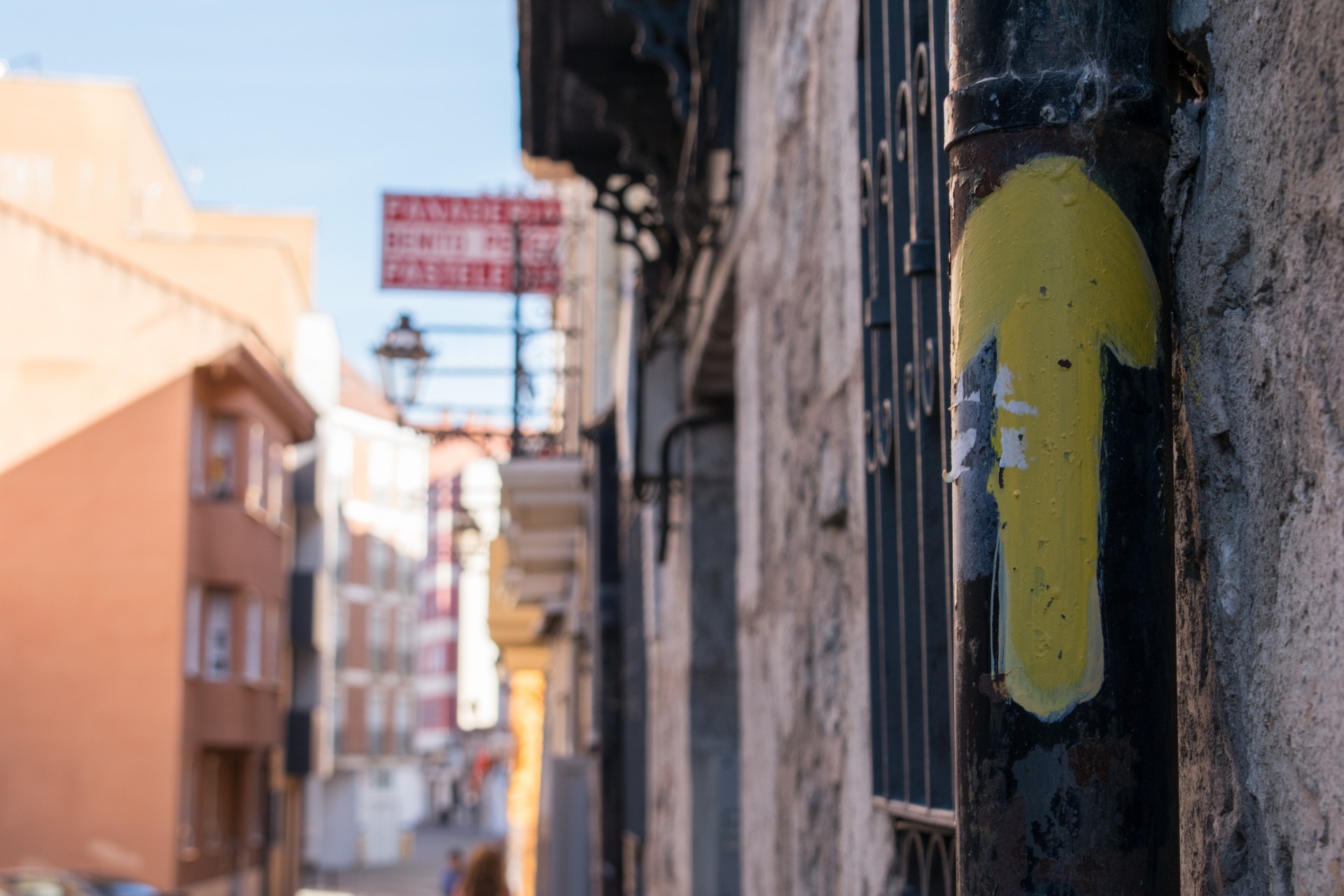
Leading up to the Holy Year, the Spanish government has invested in getting the Camino in ship shape, from signage and fountains to the foot trail itself. It declared the Holy year and event of public interest already in 2025. The infrastructure will be better than ever for 2027. As the number of pilgrims reaching Santiago de Compostela by the Camino only continues to increase, new accommodations and services continue to go up to help pilgrims on there way.
From a historical perspective, this is nothing new. Multiple medieval sources attest to the flow of pilgrims along the roads going to Santiago de Compostela in the 11th and 12th centuries. Towns like Astorga, important market cities at crossroads, had dozens of hostels for hosting travelers, whether pilgrims to Santiago or other transients. As historian R. A. Fletcher noted in his master work St. James' Catapult, the Life and Times of Diego Gelmirez, pilgrimage is simply more popular at some times than others. Ours is one those times in which pilgrimage has again become important to us.
Holy Year Versus The Compostela
The Holy year is not to be confused with the Compostela, and the two thing actually have nothing to do with each other. As I explained above the Holy Year is simply the designation of the possibility of gaining a plenary indulgence for making a pilgrimage to the tomb of Santiago. In fact, there is no right or wrong way to make a pilgrimage to Santiago de Complostela. One can go to Santiago by car or bus or train and still gain the indulgence.
The Compostela, by contrast, is a certificate that one has visited the tomb of Santiago after having traveled by bike, foot, horse, or boat on an official Camino de Santiago. Getting it requires having walked or gone on horseback at least the last 100 kilometers (or 200 kilometers in the case of riding a bicycle) as proven by your pilgrimage credential. Those going by sailing ship must have traveled at least 100 nautical miles to a port and then walked an official Camino from there to Santiago. You will be asked your reason for making the pilgrimage but providing proof of having entered the cathedral to visit the tomb of the apostle is not required. Those who do not want to attribute a spiritual reason to journey or visit the tomb of the apostle can get a certificate of distance. The Compostela is issued by the archdiocese of Santiago de Compostela, in other words the local Catholic church, which posses the official stamp.
Official Caminos
The following are the official Caminos for earning the Compostela:
Camino Francés
Camino del Norte
Camino Primitivo
Camino Inglés
Camino de Fisterra – Muxía
Camino Portugués del interior
Camino Portugués de la costa
Vía de la Plata o Camino Mozárabe
Camino de invierno
The Pilgrim’s Credential
Sometimes also called the Pilgrim’s Passport, the Pilgrim's Credential is a simple document that certifies you are a pilgrim on the Camino de Santiago. Again this is officially issued by the Catholic Church. Getting it implies that you consider yourself a pilgrim and will respect the spirit of pilgrimage on The Camino but you don’t have to profess any religious faith.
Practically speaking, to issue the credential the church works closely with the Association of the Friends of the Camino de Santiago, which has chapters around the world and which operates albergues all along the Camino. This entity has been charged with issuing the credential. Its a civic. volunteer organization founded in the 1960s without which the Camino as we know it today would not be possible.
The easiest way to get the credential is simply to go to the albergue operated by the association in the town where you start, and ask for it. They will ask for 5 euro donation.
The credential is used to demonstrate where you’ve walked on the Camino. Get it stamped at least twice a day. Many establishments on the Camino, from albergues to hotels to restaurants and shops, have a stamp and they love to offer it.
The credential is also needed to stay in the donativo albergues.
Food, Lodging, and Other Services
The long walk of the Camino can seem intimidating. However, keep in mind that this is not at all a wilderness walk. The path takes you out of town through fields, forest, and mountains, and streams, its true, but you’re walking through the heart of civilization. Walking or biking feels more vulnerable and is obviously slower than taking a car (that's the point) but the Camino is lined with a variety of services–lodging, food, medical, and transportation options. Villages and towns on the Camino are relatively close together, and as the Camino has grown in popularity, the services available have increased proportionally. In only a few sections will you will have to walk more than 4 kilometers to find the next bar! The Camino Frances is especially replete with services. Rarely would you find yourself without cell service.
It also easy to find taxis, buses, trains, pharmacies, luggage or backpack transport services, tour guides, medical clinics, banks, and shops. When walking, you will pass through a larger town where you can be guaranteed to find a large supermarket, a variety of other stores, a pharmacy, or a bank every three to four days. Nevertheless, most villages have basic services such a small grocery stores, a bar and restaurant, and an albergue. Remember, too, modern communication and transportation is always nearby.
In case of an emergency call 112.
Taxis services run all along the Camino and can be called, ask at a the local albergue or other establishment for the best phone number for local service.
Where to stay. Hotels vs. Albergues
The variety of lodging options on the Camino is only growing. Pilgrims can choose between very basic albergues that take people in a first-come-first served basis. Some are genuine charities, operated by volunteers wanting to keep the Camino experience open to everyone. Others are small, private businesses serving pilgrims, and may offer a bit more service such as private or double rooms and advanced booking. For many people, staying in these simple establishments is not just an economic choice but an essential part of the Camino experience.
Not everyone enjoys the albergue or hostel experience, however. Luckily, pilgrims can also find everything from unique bed and breakfasts to five-star hotels in historic buildings. Lodging can be booked ahead of time, too.
Will the Camino Be Over Crowded?
This concern has troubled many people for decades now, ever since the Camino took off in the 1990s. Indeed, every year it seems sees record number of pilgrims travel the various Caminos to Santiago de Compostela. When I did the Camino in 2010, about 300, 000 people got the compostela that year. In 2025, it was just over 500, 000. Next year looks be another boom year.
To be perfectly honest, the high amount of pilgrims doing the Camino in recent years is noticeable, especially on the Camino Frances, and particularly within the last 100 kilometers. Sometimes there is a bottleneck in San Jean Pie du Port, as well, since many pilgrims begin the journey. So, you’ll be encountering lots of other pilgrims everywhere–as you walk and wherever you stop. I remember, even in 2010, a small bottleneck to cross a bridge over a stream on the way out of town one morning during the final 100 kilometers. Sometimes, too, it was absolutely impossible to find a bed for the night, every single one had been taken. One night, I slept on the floor of the local gym opened up to pilgrims by the town authorities. Such is the Camino Frances in July of a Holy Year!
This is all part of the experience and even the authenticity of the Camino. The medieval sources hardly describe a pilgrimage of solitary seriousness. On the contrary, pilgrims usually traveled in groups and every type of pilgrim could be found amid the throngs going to Santiago–the serious, the penitent, the curious, and the silly. As a religious event, pilgrimage in the middle ages had a deeply celebratory and massive character.
To put it in modern terms, the pilgrimage to Santiago is as much a party as a penance and the Holy year of 2027 promises to be particularly good.