SHARE :
The Camino de Santiago: The Basics
13 of October of the 2026
The Camino de Santiago: The Complete Basics.
The Camino: Then and Now
The Camino de Santiago is essentially a kind of recreation of the medieval pilgrimage to Santiago de Compostela and its cathedral. This city almost at “the end of the earth” of Europe became a major pilgrimage destination in the eleventh century, as tradition marked it the burial place of the apostle St. James the Great. He was one of the most popular saints of the Middle Ages as miracles of all kinds were attributed to his intercession and those stories preached and spread from one end of the Christendom to the other. In the 12th century, a jubilee year—a year of great pardon in the form of a plenary indulgence—was granted to the cathedral of Santiago. And so, in the age of great pilgrimage, Santiago de Compostela became one of the three major pilgrimages of western Christianity.
In the Middle Ages, thousands of people from all over Europe, western Christendom and beyond—were making there way along the highways and byways of the continent to reach Santiago de Compostela.
Many, probably most of the pilgrims coming from outside Spain walked the route described in a medieval manuscript, the Codex Calixtinus, specifically the sections now known as the Liber Sancti Jacobi, which delineates what is today called the Camino Frances. The route described was, in its day, basically the main highway across Spain, used by tradesmen, businessmen, soldiers, pilgrims, and every other kind of itinerant. Many, of course, traveled by foot, many by cart or donkey or horse. As the anthropologist Ellen Feinberg notes, along this route they found security for their travels, companions for the journey, monasteries and other places for finding food and lodging, and the protection of local authorities. One of the most beloved and influential religious figures of the Middle Ages, St. Francis of Assisi walked the Camino Francis in the early years of the thirteenth century, a sign of the importance of this pilgrimage.
To summarize hundreds of years of history in a few sentences, times changed and so did technology and religious sentiments and practices. By the twentieth century Camino Frances was a paved highway, and most people went to Santiago by automated transportation. But the modern era is one of romanticism. The word has various definitions within philosophy and history, among them, taking inspiration from the Middle Ages, just the Renaissance looked to classical Greek and Roman culture. This eventually led to the recreation of the Camino Frances as a pilgrimage route taken by foot, which has expanded to include other routes through which pilgrims would have historically reached Santiago de Compostela.
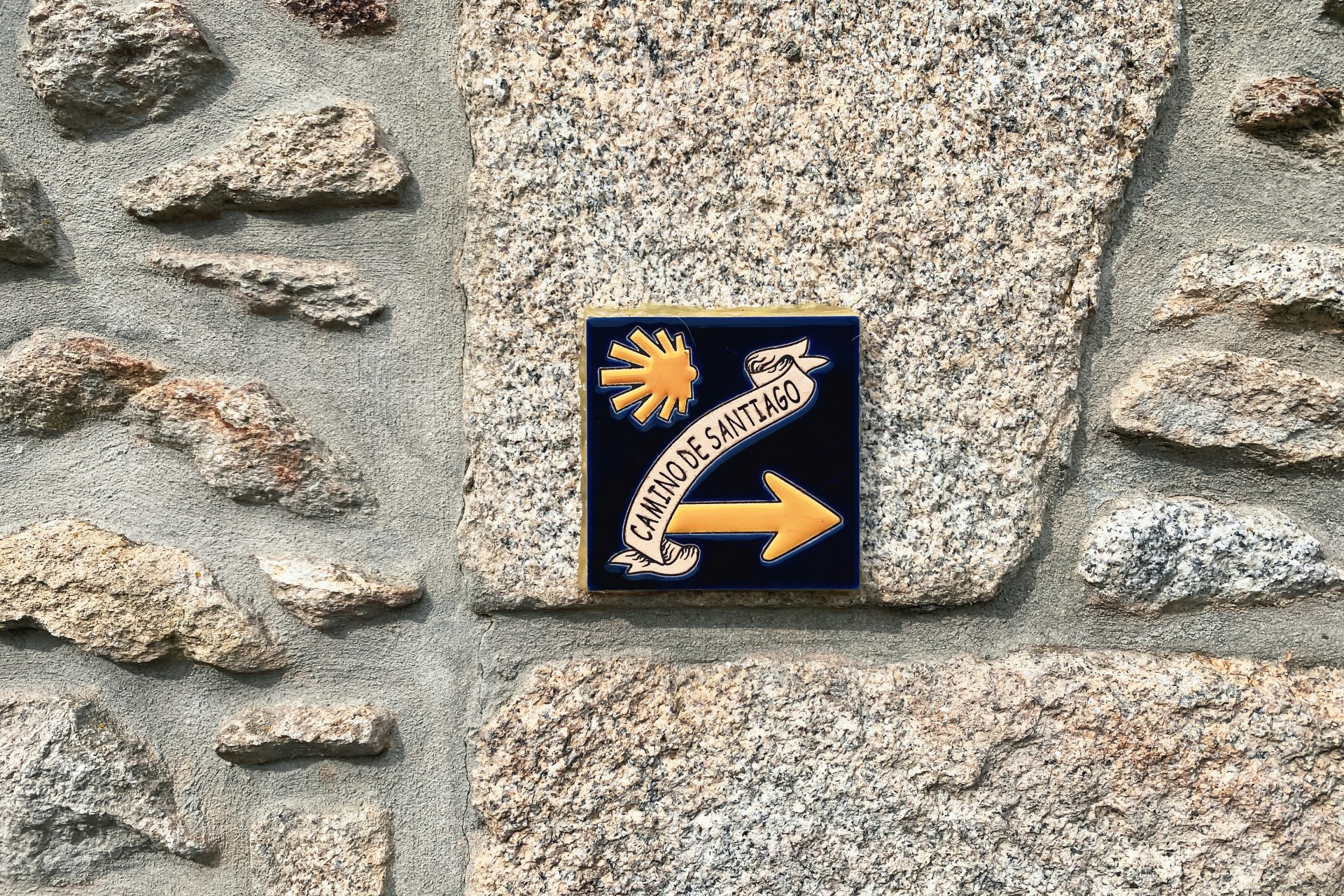
Now each year hundreds of thousands of people follow the paths marked by yellow arrows and stylized scallop shells to reach Santiago de Compostela. As in the Middle Ages, it’s a journey that is often equal parts adventure, vacation, and spiritual practice. Now, as then, too, a lot of infrastructure exists to help pilgrims on their way.
This is a very short guide to that infrastructure and some basic spiritual-cultural considerations important to doing The Camino.
Official Routes: Starting Points in Spain, Length, General Considerations
Camino Francés:
This one is the most classic and historic of the routes. It starts in Roncesvalles, though sometimes is easier to start in San Jean Pie du Port just over the border in France. It runs 780 kilometers from San Jean. The last hundred kilometers start in Sarría, Spain. It goes through several high mountain passes and as well as a long stretch of flat land across the Castilian plain, la meseta. By the 12th century, it had become the main transportation artery across Spain for those coming from the east. In other words, it was the main highway used by everyone from soldiers to kings to traders to pilgrims. Major highways still follow the same route across Spain today. In parallel is the footpath, which for pilgrims on foot also offers the most built-up infrastructure, best waymarking, and the most iconic places. Its excellent for those going alone, for the first time, or wanting a classic Camino experience. Good for groups, too. The last 100 kms are easy terrain. The whole thing takes from 30 to 35 days. Visible on GPS maps.
Camino del Norte: This one starts in San Sebastian. The terrain varies between hugging the Cordillera Cantabria. It joins the Camino Frances in Galicia. It runs 822 kms. While it traverses beautiful scenery and villages, as a pilgrimage route to Santiago de Compostela, It was basically developed as an alternative to Camino Frances. Despite its lack of historical grounding, it seems to have indeed captured much of the Camino spirit and has become the second most taken Camino. The infrastructure is good but not as dense as the Camino Frances. Visible on GPS maps
Camino Primitivo: This one starts in Oviedo, the old capital of the Spanish Visigoth kingdom following its near destruction by the conquest of much of the Iberian Peninsula by the Umayyad Empire in the eight-century. From there Alfonso II, the Spanish king, first visited the site of tomb of St. James in the ninth century, ana ct that help to ratify the authenticity of the site as the burial place of the St. James. He built the first church on the site, too. It is a beautiful, rugged, mountainous Camino. It has infrastructure but requires a bit of planning as there are some long, hard stretches with few places to rest or sleep. It has been growing in popularity. 309 kilometers. Visible on GPS maps.
Camino Inglés: 74 kms. It starts at the coast in A Coruña, where ships from England would have landed. The terrain is relatively gentle and the infrastructure good. Visible on GPS maps
Camino de Finisterra – Muxía: This is the stretch past Santiago de Compostela to the coast considered the end of the earth in the Middle Ages as it was basically the last know piece of land before the vast Atlantic Ocean, which was back then, practically unnavigated.116 kilometers. Good infrastructure. Visible on GPS maps.
Camino Portugués (interior route): Starts from Lisbon, reaching Santiago from the south. It’s considered gentler than the Camino Frances, for example. 619 kms. Visible on GPS maps.
Camino Portugués (costal route): Essentially a variant of the Camino Portugués from Porto, it follows a close to the coastline, rejoining the main route near the Spanish city of Pontevedra. Relatively gentle with good costal views. Visible on GPS maps.
Vía de la Plata: This follows an ancient north-south route long used by the Roman Empire, those who preceded it, and everyone who has come since then. It starts all the way down in Seville and joins the Camino Frances in Astorga. It is not for the faint of heart as it is long and very, very hot during summer. There are stretches that are little marked and have little infrastructure. The section from Zamora (on the northern Castilian plain) is visible on satellite maps. From Zamora to Astorga is only 94 kms, and Zamora is a beautiful, underappreciated city.
Food and Water.
Spain is a highly developed country, of course, and one known for its dense number of bars! Almost every village on the Camino Frances has at least bar. With few exceptions you will walk through a village every 4 kilometers, and so to a bar. The Caminos do not go through wilderness areas and often follow parallel to highways and roads, though usually at some distance. There is everything from grocery stores to small bars to restaurants all along the way. It’s only necessary to carry a snack in case you need something between towns.
Water fountains, too, are frequent. Some run on treated municipal water and some are artisanal springs. Locals drink from both, often preferring the untreated water. Bottled water can also be purchased along the way.
I have lived in Spain for eight years and never gotten sick from an artisanal fountain.
Lodging
Accommodation on the Camino varies from simple albergues or hostels with dorm rooms to five-star hotels and tourist apartments. Many albergues are non-profit operations run by volunteer groups in the spirit of hospitality and others are private businesses. Many accept reservations ahead of time, increasingly even those that have traditionally operated on a first-come-first-served basis.
Along the main Caminos, accommodation is usually found frequently so you don’t have to walk long stretches to find a place to sleep.
This website is one of the most comprehensive sources about albergues on the Camino: https://www.alberguescaminosantiago.com/guia-de-albergues-por-ciudades-y-pueblos/
Guide Books and Apps
As one can imagine smart phone applications have largely made printed guide books obsolete. As I mentioned about, most of the Caminos can be followed on GPS maps, which are included in these apps. In many cases they can also be downloaded for use offline. They include other features of a guidebook, such as information on lodging, sites found along the way, and cultural-historical information to enrich and educate.
Camino Tool and Wise Pilgrim are two of the best apps, with satellite maps of the trail and tons of information on the infrastructure available along the way.
For hard-copy guide books the late John Brierly’s A Pilgrim's Guide to the Camino De Santiago: Camino Frances St. Jean Pied De Port – Santiago is still considered an absolute classic, for its practical accuracy and insights into the cultural-spiritual aspects of the Camino.
Luggage Portage
This service is easily available and can be booked in advance or on short notice, depending on the service provider.
The most affordable and flexible option is offered by the Spanish postal system, Correos. You reserve online, ahead of time or even just the day before. Reservations must be made by 8 p.m. the previous day. That is also the time frame to cancel a reservation. You can transport a backpack or suitcase weighing up to 15 kg, which is about 30 pounds. You identify your bag with the reservation information provided to you when you make the reservation, and most lodging facilities along The Way have the official tags from the post office The beauty of it is that it operates everywhere in Spain.
They also have a service for pilgrims to ship luggage directly to Santiago or other cities in Spain. Called the Pilgrim Pack, it can be contracted directly at a post office or online (and then take your package to a post office or other drop off location).
Additional services include luggage consignment and bicycle transportation.
There are also private services available. For the Camino Frances the most well established is Jacotrans. Services also include bicycle transport and luggage storage.
Other options are Camino Facil and Pilbeo, which cover more areas.
Trains, Buses Taxis
Taxis service is usually easily available along the main Caminos. In small towns, the best way to find one is to simply ask at a hotel, or pilgrim hostel, as they will have phone number to call or can call one for you. Buses reach to small town and many villages in Spain. Service is good but operated by private companies and there is no central place to look for buses. In towns, there will be a bus station, in many villages a bus stop. Apps like Rome to Rio or Omio can be helpful, as are the Camino-specific apps. Asking locals is also a great option.
Trains also run between cities and even villages along many Caminos. Renfe is the Spanish Spain service and most trains appear there, but not all. Again, asking at a albergue is always a good source.
Laundry Services
Laundry mats and similar services are available in many towns.
The Compostela
The Compostela is a certificate issued by the cathedral of Santiago de Compostela certifying that a pilgrim has walked at least 100 km along an official route, or cycled 200 km, specifically the last 100 km (or 200 km if cycling) into to the city. In other words, you must have done the last 100 or 200 km along an official pilgrimage route, and you must attest that you did it for spiritual reasons. If you meet the physical requirement but do not want to affirm any spiritual motivation, you can get a certificate of distance. Both are issued in the pilgrim’s office near the cathedral.
The Pilgrim’s Credential
Sometimes also called the Pilgrim’s Passport, the Pilgrim's Credential is a simple document that certifies you are a pilgrim on the Camino de Santiago. Again, this is officially issued by the Catholic Church. Getting it implies that you consider will respect the spirit of pilgrimage on The Camino but you don’t have to profess any religious faith.
Practically speaking, to issue the credential the church works closely with the Association of the Friends of the Camino de Santiago, which has chapters around the world and which operates albergues all along the Camino. This entity has been charged with issuing the credential. Its civic. volunteer organization founded in the 1960s without which the Camino as we know it today would not be possible.
The easiest way to get the credential is simply to go to the albergue operated by the association in the town where you start and ask for it. They will ask for 5 euro donation.
The credential is used to demonstrate where you’ve walked on the Camino. Get it stamped at least twice a day. Many establishments on the Camino, from albergues to hotels to restaurants and shops, have a stamp and they love to offer it.
The credential is also needed to stay in many volunteer-based albergues, such as those run by the Assocation of the Friends of the Way of St. James.
Guides and Travel Services
Guided trips on the Camino and pre-planned packages are widely available, as are travel agencies and travel agents that specialize in helping plan Camino journeys. There can be very useful and helpful, whether going alone or planning a group trip.
The Spiritual Basics
The essence of the Camino de Santiago as a historical pilgrimage, and even a contemporary one in the strictest Christian sense, is that the physical remains of St. James, called relics in Catholic spirituality, are housed in the cathedral of Santiago de Compostela. This fact made that church a pilgrimage destination, as relics are considered sources of spiritual power in connection with the holiness of the saint. This is an ancient belief and practice in Christianity. St. Augustine of Hippo, for example, wrote in the 5th century about the miracles wrought thought he presence of the relics of saints. During his era, pilgrimage as we understand it now in the Christian tradition was in its first development.
Another important aspect of the cult of saints is the saint’s feast day, the day dedicated to honoring the holy person and celebrating their passage into heaven—in other words, death—from where they intercede. In the case of St. James, the Great, the feast day is July 25. The celebration takes place not only in the religious ceremonies inside the cathedral, principally mass, but spills out in the civic life of Santiago de Compostela in a series of events and general atmosphere of festivity that culminates on the night of July 24th with a fireworks celebration most visible in the large plaza in front of the Cathedral. The city is filled with pilgrims and revelers. It’s a good time with a lot of crowds—a classic Spanish festival.
Jacobean Holy Years
On a recurrent cycle this feast day gets heightened into a Jubilee year, the Compostela Holy Year—also known as the Jubilee Year, the Jacobean Year, or *Xacobeo*—is celebrated whenever July 25th falls on a Sunday. It follows a sequence of 6, 5, 6, and 11 years, thanks to the irregularities of the Gregorian calendar (leap years). 2027 is a Holy Year. Following 2027, the next Holy Years will be celebrated in 2032, 2038, and 2049.
The tradition of the Compostela Jubilee dates to the 12th century. The Cathedral of Santiago standing today dates to 1122, during the pontificate of Callixtus II. The jubilee year was granted by Pope Alexander III in 1179. In Catholic spirituality, the jubilee is considered a special year of grace or forgiveness of sins, as represented by the opportunity to get a plenary indulgence that year and the opening og the Holy Door, the Door of Pardon. The whole year will be marked by a series of special events organized by both civic and ecclesiastical authorities. In other words, it will be an intense and exciting year in Santiago de Compostela, particularly in July.
Now you’re ready to really start planning your Camino.
About Bridget Ryder and Cultural Travel Spain
I'm a travel agent and writer living in León, Spain. I'm an award-winning jouranlist and love sharing insights and stories of Spanish history and culture. As a travel agent, I can help make you next trip to Spain a seamless and unforgettable experience. I work with everyone from solo travelers to large groups. Contact me today.