COMPARTIR :
Lamb Lunch and a Fortress Church in a Dusty Camino Village
23 de Septiembre del 2026
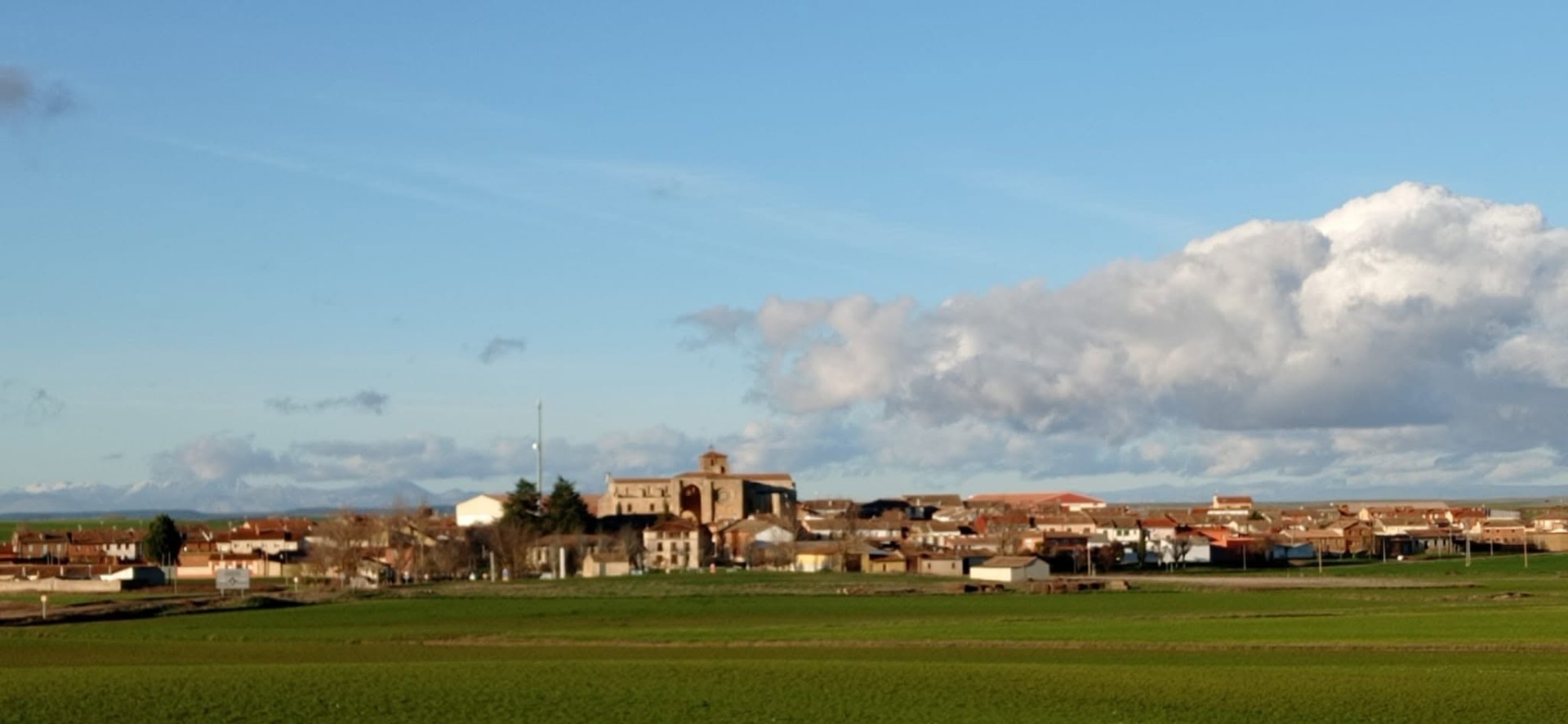
Now a tiny village in a giant, globalized world, it’s a contradiction of a place–the massive fortress-church rising above a scrappy, weary-feeling, half-empty, dusty town on the northern Castilian plain. At least, this was the impression I had on fine Saturday last May when we met some friends there for lunch.
Villalcázar de Sirga represents the Camino de Santiago in its modern form.

The church itself belies the history that built it. The days when knights and nobles, peasants and pilgrims roamed up, down, back, and forth along this expanse of land, contesting each other’s power and caring for the weak, while also forming, unbeknownst to them, the cultural legacy we today simply call The West. Indeed, the historical legacy of the town–pilgrimage and Christian knighthood–speak ot that spiritual fervor that repurposed the sword for peace and protection precisely of the weak while sending masses of pilgrims to Santiago de Compostela.
Again harkening back to those medieval power struggles, the name of the town combines the Latin noun Villa and the Arabic al-qaṣr, meaning palace or fortress, which in turn is a derivative of the Latin castrum, meaning castle or military garrison. The last part, sirga, has two references, according ot the website Xacopedia, one an old Castilian word for the more modern camino. Its a designation applied to other villages in Spain along the old pilgrim route, particularly those where the road went right through town, forming also the principal street in that place. Such is the case in Villalcázar. Additionally, it can refer to the ropes used to pull small boats upstream on rivers.
To Villacázar, both of these meanings could apply. Already in the documentation of 1069 this town was cited as Villasirga, as the Ucieza River runs along the town. The pilgrim, in fact, walks into town along the dirt road following the river, walking past La Ermita de la Virgin del Río, which has its own intersting history, before reaching the where the town properly begins.
The big church, of course, instantly commands everyone’s attention. Simply its massive size implies a disproportionate importance, at least at some point in history. Construction began in the 12th century as the romanesque style was giving way to gothic, so this church represents architecture in transition. Its dedicated to Santa Maria la Blanca, roughly translated as Holy Mary in White. Some dozen churches throughout Spain also invoke the Virgin Mary under this title, which is likely actually the Spanish reference to Our Lady of the Snows, a title which in turn comes from the miraculous snowfall in Rome on August 5, 352, that lead to the building of St. Mary Major.
In any case, in the 12th century, the king of Castile and Leon, the Alfonso X, known as The Wise, had a deep devotion to this church and the Virgin Mary in general. Many believe the Cantigas de Santa Maria, a collection of 417 songs about the Virgin Mary written in his court, some of them composed by the kings himself, are dedicated to the Santa Maria la Blanca of Villalcázar de Sirga. This is evidence, too, that miracles were attributed ot Mary’s intercession at the temple. The king’s brother Sancho VI made several penitential pilgrimages to the church during Holy Week. Though on the Camino de Santiago, the temple was its own object of pilgrimage not only of royalty but also of commoners.
By the 14th century, and just a few years before they were disbanded by the pope, the Knights Templars had been given the rights to village and the church, as well as charged with the care of pilgrims, the poor and other travelers. When the Templars came toe end, it àssed to the Order of Santiago.
Now the town has revived thanks to the modern pilgrimage and its own appreciated of historical legacy.
The temple is now cared for and watched over by locals. They ask a 5 euro admission to see inside but are quite friendly and chatty. They enjoy sharing their local patrimony.
One of the artistic-historic highlights of the three medieval tombs, those of Felipe de Castilla ( brother of Alfonso X), Inés de Guevara (Felipe de Castilla’s second wife), and that of Juan de Pereira, a knight of the Order of Santiago. They have been gathered, along with the other most important movable items in the church in one side chapel, the chapel of Santiago, enclosed by a fence. I lamented to the docent that I couldn’t get a better look, at which he open the gate and let me in with my three-year-old daughter in tow.
There I could see up close the beautiful carving on the tombs and what remained of the lively colors all these years later. We could also appreciate the titular statue of the Virgin Mary in White.
He happily explained to me some other interesting features of the church, such as the old well and the aquifer that ran underneath. We both agreed that the church emitted a special energy.
Today, the old pilgrims’ hospital next to the church is restaurant, the one I had lunch in in fact, and very recommendable. We got the house specialty, roast lamb. Every meal can end with Cafe del Pergrino, cofee with a shot of aguardiente, after which you will want a siesta.
Now, a small albergue on the donativo system is run by the Oder of Malta in the old school house of the village.
It’s a worthy stop on the Camino de Santiago.